
Much of today’s conversation about young people and smartphones focuses on the risks: excessive screen time, addictive design, and potential harms to well-being. These concerns matter. But they are only part of the story.
I was pleased to contribute to a recent Eindhovens Dagblad article by Emma Thies exploring the often-overlooked positive side of young people’s digital lives, alongside fellow researchers Lara Vreeswijk (Radboud University) and Lise-Marie Nassen (University of Amsterdam). One point I emphasized is the role smartphones can play in supporting young people’s growing autonomy. From navigating unfamiliar places and making appointments to managing payments, staying connected, and finding information independently, smartphones give adolescents opportunities to navigate everyday life in ways that previously depended much more heavily on adults.
This matters developmentally. Adolescence is a period of growing independence, exploration, and learning to make decisions. Digital technologies can support that process, provided young people have the skills and guidance to use them well. Our (together with Annemarie van Oosten, Roos Korderijnk, Claes de Vreese, and Dian de Vries) ongoing national research reinforces why this guidance matters. Recent Dutch data from Project CID suggest that while young people demonstrate strengths in navigating information and solving digital problems, they still need support developing other competencies, including transactional skills – namely, the ability to independently manage practical tasks online, such as making appointments, completing forms, or handling digital payments. Access to technology creates opportunities for independence, but it doesn’t automatically equip young people to take advantage of them.
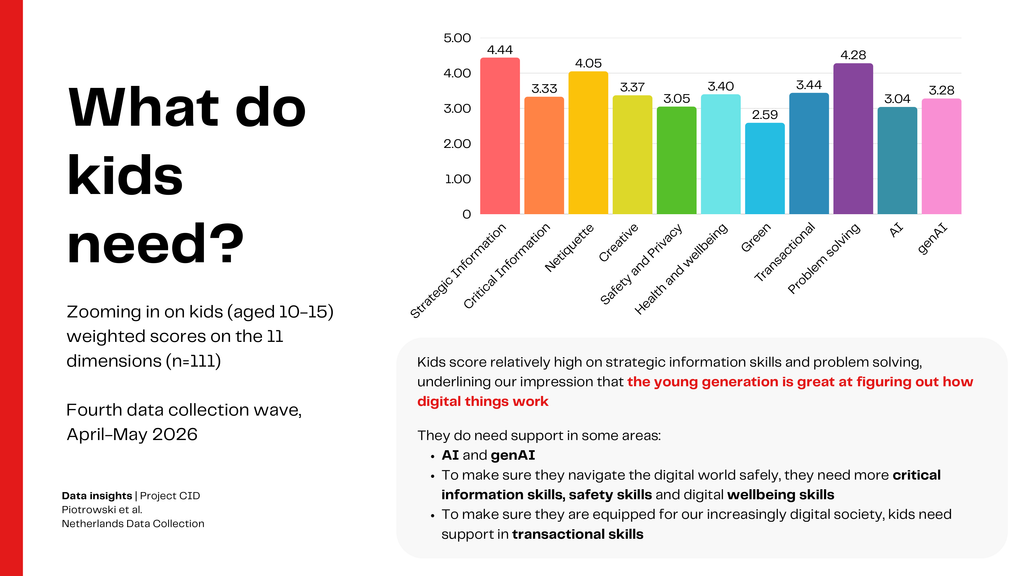
Figure: Digital competence across 11 dimensions among Dutch youth aged 10–15. Project CID, fourth wave (April–May 2026; n = 111), Piotrowski et al.
As I often emphasize in my work, protection and empowerment are not opposing goals. We need to take digital risks seriously while also recognising the opportunities technology provides for learning, connection, and participation. The question isn’t simply how to keep young people away from smartphones. It’s how to ensure they can benefit from digital technologies while developing the competencies to navigate them safely, critically, and independently.
Read the full article (in Dutch): Emma Thies, “Verslaving, hoge schermtijd? Ja, maar telefoon heeft ook andere kant voor jongeren: ‘Wereld ligt aan je voeten‘,” Eindhovens Dagblad, 18 October 2026.