
My inbox is flooded with questions from journalists that center around one question: “do you favor a social media ban for youth?” In short, no, I do not. Below I offer a lengthy explanation as to why. Happy reading. The Framing Europe’s debate about children’s online safety is becoming increasingly focused on age limits. But Read More

Child Safety Online
On 13 July, the final commissioned report “Child Safety Online: Protecting and Empowering Minors in a Digital World” was published. I was pleased to contribute to the work of the Special Panel. Convened by President Ursula von der Leyen, it brought together researchers, practitioners, youth and parent representatives, and specialists from fields including health, psychology, Read More

A Message for 2026 Graduates
I wrote and delivered this speech to the graduating Communication Science Master’s degree cohort at the University of Amsterdam. Due to high request, and upon high exception, I am publicly releasing the (unedited) speech. May it inspire many to be brave and remember their humanity. Our future is in your hands, dear graduates. Take care Read More
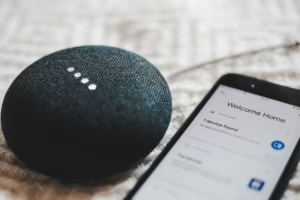
What does the news say about Siri, Alexa, and co.?
My team and I have a new article out in New Media & Society (lead authored by Rebecca Wald along with Theo Araujo, and Annemarie van Oosten) that looks at how Dutch news media have portrayed virtual assistants – Siri, Alexa, Google Assistant, and related systems – over the past decade. Using a large corpus Read More

llusion or Impact? Shaping Social Media Policy for Youth
(Note: A Dutch version of this article appeared in IDEE in December 2025, download below). Across the globe, proposals to ban or severely restrict young people’s access to social media are gaining momentum. In Australia, lawmakers have raised the minimum age for social media accounts; in the United States and parts of Europe, similar restrictions Read More
€3.2 million grant for research on digital watermarking to combat online impersonation
Thrilled to share that AuthentiMark has received a €3.2 million research grant through the KIC Mission Digital Identities programme of Netherlands Organisation for Scientific Research (NWO). AuthentiMark is a broad consortium bringing together researchers across disciplines and partners from key sectors including government, healthcare, and the financial sector. The project is led by myself, together Read More

Ban the Business Model, Not the Child
Australia’s new under-16 social media rules are now live. In plain terms, they function as a delay on having accounts: young people (and parents) aren’t penalized, but platforms must take “reasonable steps” to prevent under-16s from holding accounts, with civil penalties that can reach A$49.5 million. The debate feels decisive. That’s the problem. Because when Read More

🌟 Researcher Wish List: Navigating Digital Infrastructures for SSH Research
I was happy to deliver a keynote at the LBDI-SSH Expert Meeting in Utrecht on November 18, 2025. The presentation, titled “Studying the Sometimes Unresearchable: My Researcher Wish List“, focused on the urgent needs and structural challenges facing social sciences and humanities (SSH) researchers trying to work with digital data and platforms. In the presentation, Read More

New Findings: We Are Less Digitally Skilled Than We Think
Our team at the University of Amsterdam*, just released new findings on the state of digital competence in the Netherlands — and the results are surely interesting! In short: most Dutch people think they’re digitally skilled, but our data show that their actual abilities don’t always match. Using our updated DigIQ 2.0 instrument, we surveyed Read More
Helping Kids Get Smart About Media — My Collaboration with Kidsweek
This week marks the Week van de Mediawijsheid in the Netherlands: a nationwide initiative focused on helping everyone, young and old, use media in ways that feel healthy, balanced, and positive. It’s one of my favorite times of the year because it brings attention to something I care deeply about: guiding children toward confident, thoughtful Read More